
- They insist on the importance of avoiding sunburn and especially protecting children, people with phototypes 1, 2 and 3 and also those with many moles. "The risk is multiplied by 2 with 50 moles on the body and by 4 with 100 or more," they explain.
- They recommend prudence and common sense when sunbathing this summer, in addition to using a protection factor of 50+, a hat, sunglasses, and avoiding the central hours of the day.
Sanitary group dermatologists Ribera recommend a periodic control of moles to detect suspicious skin lesions and treat them in early stages. Every year around 7.500 cases of melanoma are diagnosed in Spain, which represent 4% of malignant skin tumors, but are responsible for 80% of deaths, especially in cases where it is not detected early. This is confirmed by the dermatologist Ribera Polusa (Lugo), Javier Concheiro. “It is a type of skin cancer that in its early stages is practically cured in 100% of cases, but that in advanced cases it can become complicated”, he assures.
Raquel Pardavila, dermatologist at the hospital Ribera Povisa (Vigo), explains that "in general, patients are advised to do self-examinations several times a year but, in the case of patients with risk factors such as a personal or family history of melanoma, those with more than 100 moles or with moles Atypical patients, those who have had sunburn or chronic sun exposure, phototypes I and II, genetic diseases that predispose to skin cancer such as albinism or xeroderma pigmentosum, or patients with immunosuppressive treatment, require more frequent check-ups by a specialist in Dermatology." .
Dr. Concheiro insists on the importance of controlling sun exposure, especially in the cases of patients at risk, with special emphasis on people with many moles. "If a person has more than 50 moles on their body, the risk of melanoma is multiplied by two, and if they have more than 100, by 4. "If there are more than 10-15 moles on their arms, they are patients who are going to exceed these figures”, he adds to facilitate the computation. And he adds. “The sun is the main risk factor for skin lesions, especially in summer overexposures, what we know as intermittent exposure, since melanoma and basal cell carcinoma arise like this, from a burn, and that is why it is It is very important to protect yourself from the sun correctly”, he explains. That correct protection involves using photoprotective creams, wearing hats, glasses and a T-shirt, and also avoiding sun exposure in the middle of the day. "Prudence and common sense are important, use high protection factors and do not forget to reapply the cream from time to time and after bathing," he assures, and as far as possible, he explains, avoid sun exposure when the radiation factor is equal to or greater than 8. In addition, Dr. Pardavila recalls that these measures "must be taken not only when going to the beach but also when doing outdoor activities, such as walking or practicing sports or working outdoors" .
For self-examination, both Dr. Concheiro and Dr. Pardavila recommend following the ABCDE rule to detect changes in different aspects of moles: A for asymmetry, B for border, C for color, D for diameter, and E for evolution.
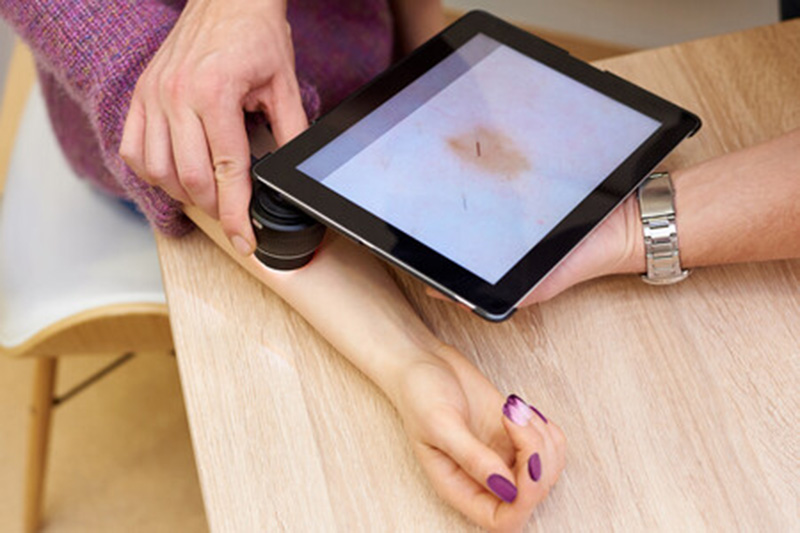
Dr. Pardavila explains that dermoscopy can be used to study skin lesions "in a non-invasive way, using a dermatoscope, a magnifying lens with polarized light that allows us to see structures and patterns that cannot be seen with the naked eye. thus improving diagnostic accuracy. In addition, she recommends mole mapping, that is, a photographic record of the pigmented lesions in patients at risk, using a digital dermatoscope, which is associated with a camera and software to store macro and dermoscopic images of moles. "In this way, specialists can compare them in the following reviews and detect if new lesions have appeared or if changes have occurred in the pre-existing ones," she says.
In addition, the specialist from Ribera Povisa recalls that, although the majority of melanomas are generated on pre-existing pigmented lesions, that is, moles that undergo some change, but that can also appear "de novo" in areas without previous lesions and even in extracutaneous areas as at the eye level, oral cavity, nasal passages or gastrointestinal mucosa, although these cases are much less frequent than on the skin.
Lastly, Dr. Concheiro recalls that melanoma is often “a type of indolent cancer”, which is why it can go unnoticed, and self-examinations and visits to a specialist are necessary in the aforementioned cases. However, he points out, in his opinion, “since the pandemic, there is more general health concern, including skin problems, and not just cancer, but also psoriasis, dermatitis or acne. Citizens are more aware of the need for regular reviews, ”he points out.